Could a B.C. Policy Fix the Issue?
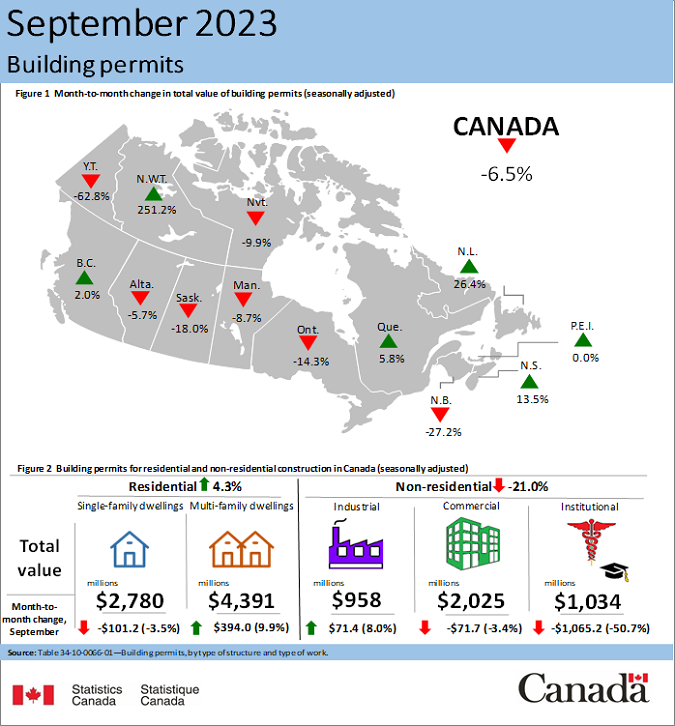
Now you look at the data above you can see that not all provinces have a decrease in the application of building permits but nationwide we are down 6.5%. So what?
Recently, we had the Bank of Canada and the federal government talk about how their decisions would take into account infrastructure impact. Announcements like this inevitably led to some comical Instagram & TikTok reels about how things such as interest rate increases & population migration(including immigration) affect housing supply.
I have also noticed that the BC has implemented some policies that are aimed at infrastructure and supply-side efforts to boost rental supply and perhaps by extension housing affordability. The increased densification efforts include:
- Requiring minimum building heights (ie. stories) based on proximity to metropolitan transit hubs. For example, any new construction within 200M of a SkyTrain Station has to be at least 20 stories high.
- If you own a single-family lot in a community with a population of at least 5,000 you can now build a multi-family property based on lot sizes(It was more of a policy aimed at duplex and triplexs as opposed to an eight-plex)
Now the questions that come to me as someone looking at this become:
1) Will similar policies come east to Ontario to alleviate supply issues in major CMAs like Toronto but even smaller communities?
2) How do we get past this NIMBY mentality and will it serve as a constraint as political policy?
Admittedly, I think the policy could come east but I think the NIMBY mentality will slow down the timeline before we see impact. NIMBY is an acronymtriplexes that stands for “Not In My Backyard” and there are many instances that have been in cities both big and small. I have seen stories in Toronto but have even seen it in my hometown of St. Thomas with the Tiny Homes project. The idea behind NIMBY generally presents as this:
Person #1: Real estate & rent are so expensive … we need to do something to make it affordable like increasing units for rent
Person #2: Well there is a planning effort to build a 3-story apartment building around the corner from you.
Person #1: Why would they do that? That is going to bring down property values
(This may have been a conversation I had 3 years ago)
A Lending/Development Issue
Assuming there is sufficient buy-in and power to get behind a development the next point of consideration is whether or not a developer will consider financing at elevated interest rates. These projects need to be financially viable to move forward so often the answer is believed to be no.
The question then becomes: if institutional lenders support development but are priced high because of the perceived risk – should the government step in and underwrite the infrastructure projects at more attractive terms?
I would say that this becomes more of a philosophical question in that it requires two items of reflection:
1) Where do I stand on government intervention in markets?
2) What is more important – the chicken or the egg?
The argument is that if developments never happen then we can’t alleviate the supply issue(the egg). Therefore, affordability never normalizes which then becomes a bit of an infinite loop that begs the question of how we break the cycle.
The last wrinkle (assuming I haven’t lost you) is: How would government involvement affect inflation? (it will likely go up)
(Note: There are positive and negative outcomes of times when government has stepped in these infrastructure projects)